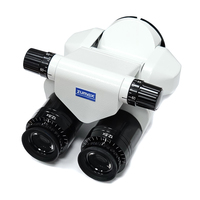
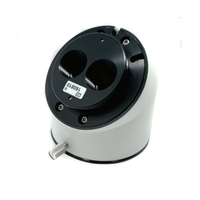
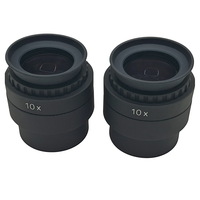
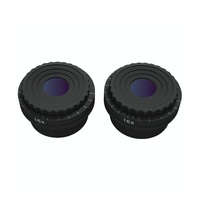
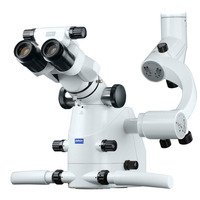
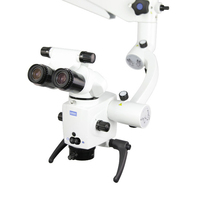
Zumax OMS 2380 dental microscopes
- Zoom Magnification 0,4x -2,4x
- Integrated 4K or 4K-3D camera System (optional)
- VarioDist Objective Lens 200–450 mm
- FluoDet™ Fluorescent Module (optional)
- Twin Switchable LEDs Illumination
- AntiReflect Module (optional)
- FreeMov® Balancing Arm
- Brightness: 70,000lx (at 250mm working distance)
Technical specifications
- Continuous adjustable zoom system: 0.4x – 2.4x
- Head: 0–190° tiltable, ergonomic binocular tube, f = 170 mm
- Eyepieces: 12.5x/17.7 mm wide-field eyepieces
- Diopter adjustment: +/-7D
- Interpupillary distance adjustment: via PD adjustment knob (54–76 mm range)
- Integrated VarioDist objective lens, F=200–450 mm, working distance = 250 mm
- Illumination intensity at 250 mm working distance: >70,000 lx
- Illuminated field: 160 mm (with f=250 mm objective)
- Field of view: 123.8 mm ~ 11.6 mm
- Filter changer: yellow, green (red-free) filters
- Dual, integrated, single-finger-operated focusing handles (left/right hand) with image freeze and capture functions, and sterilizable covers
- FreeMov® balancing arm system: torque and damping adjustable according to head load to maintain microscope balance (2 balancing knobs, 2 balancing adjustment knobs)
- Arm system dimensions: 1520 mm (primary arm 500 mm – rotation ±350°, secondary arm 720 mm – rotation ±150°, balancing arm 300 mm)
- Head range of motion: ±300 mm
- LED illumination system with backup light source, continuously adjustable brightness Lifespan of at least 60,000 hours
- Arm equipped with an automatic activation system
- Standard configuration: mobile floor stand (632 x 632 mm footprint) with four lockable casters
- Weight: 100 kg
Head-tilting function (optional)
Designed specifically for clinicians. Maintains the horizontal viewing position of the binocular tube. Allows for a head tilt of +/- 25°.
Integrated 4K camera with USB storage (optional)
Zumax offers outstanding UHD resolution and excellent color reproduction, combining high precision with cost-effective operation. The system delivers a 3840×2160 resolution image via HDMI output, with a resolution of up to 1800 TV lines.
The optional recording system allows for capturing still images and videos, as well as saving data directly to an internal USB drive. Recordings can be played back immediately using a mouse.
Recording can be triggered in several ways: via a wireless foot pedal or by using the photo and video buttons located on the handles.

FluoDet™ is a fluorescence-based diagnostic mode that aids in the precise identification of caries, bacteria, and composite materials, thereby supporting minimally invasive treatment. When ordered, it is installed in place of one of the dual LEDs.

The anti-reflective module reduces distracting reflections and glare in the treatment area. This results in a clearer, higher-contrast image, making fine details (e.g., cracks, margins) more visible. It is particularly useful in wet, reflective environments and during photo/video documentation.

The laser filters inserted into the slider are matched to the wavelengths of various dental lasers, protecting the operator and improving visibility. The system supports multiple laser types (e.g., Argon, diode, Nd:YAG) and filters out distracting or hazardous radiation through the selection of the appropriate filter. This ensures safer operation and a clearer, higher-contrast image during the procedure.

Naked Eye 3D system (optional)
Zumax 4K–3D Digital Imaging System
Designed for integration with the Zumax OMS2380 microscope, this system delivers detailed, stereoscopic images without the need for 3D glasses. Its 15.6-inch 4K UHD display uses eye-tracking technology to adapt the image to the user’s eye position, supporting depth perception.
Viewing through the monitor allows a more comfortable working posture and greater freedom of head movement. Switching between optical and digital viewing supports everyday procedures, teaching and demonstrations.
- Dual 4K imaging with a resolution of 3840 × 2160 pixels
- Glasses-free 3D display with integrated eye tracking
- Dedicated FPGA image processing for low-latency viewing
- 2D and 3D display modes
- Ergonomic operation, reducing dependence on a fixed eyepiece viewing position